Navajo Technical University students visit UNM for solar panel workshop
February 16, 2026 - Carly Bowling
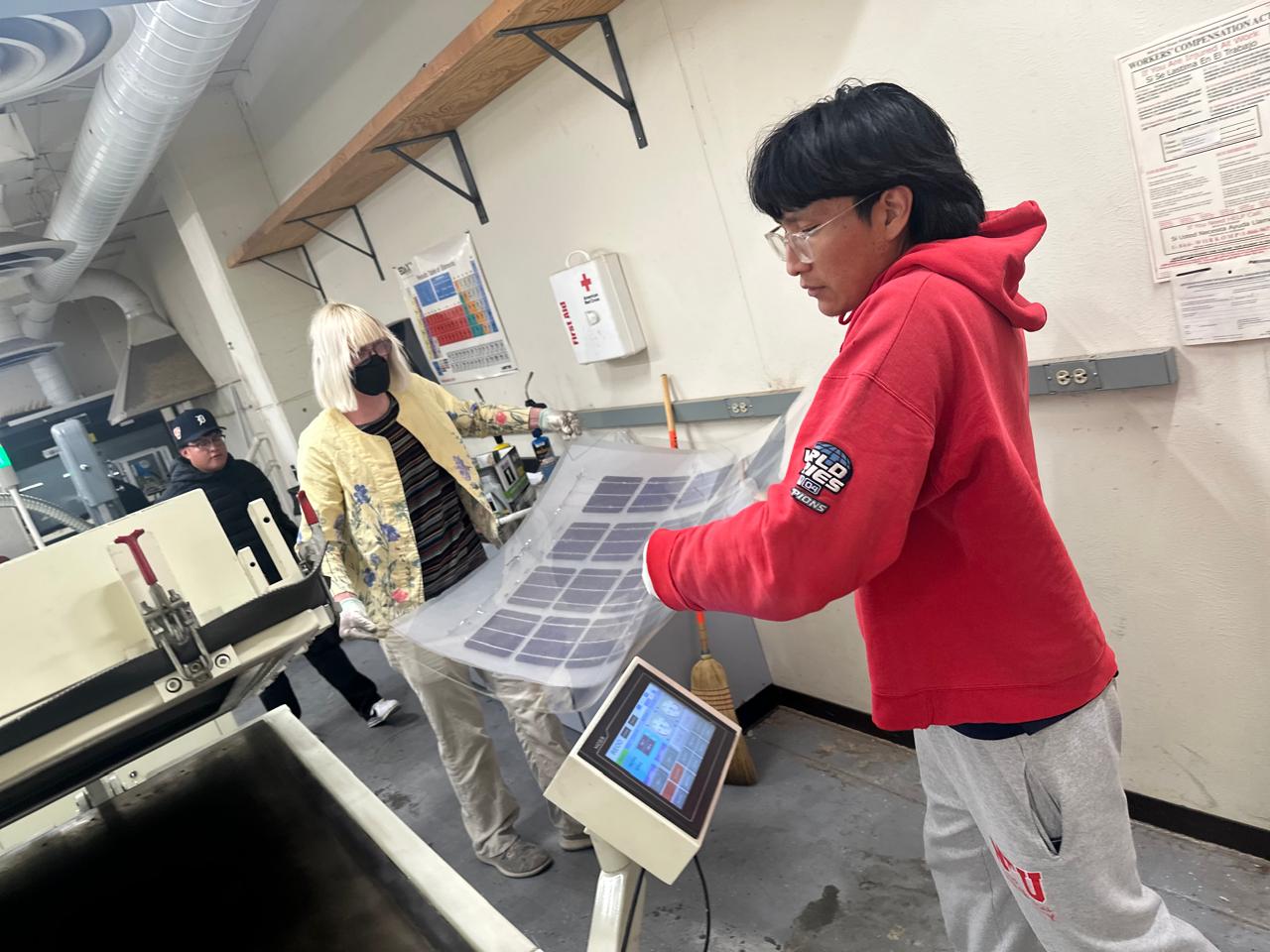
Students from Navajo Technical University visited The University of New Mexico School of Engineering last semester to build solar panels for use in agricultural settings.
The late fall workshop was hosted by Tito Busani, associate professor in the Department of Electrical and Computer Engineering, and Duncan McGraw, a Ph.D. candidate in the Optical Science and Engineering Program, and aimed to provide students with a complete start-to-finish tutorial in building an agrivoltaic microgrid.
The work expands on a research project, funded by the Department of Energy, currently deployed at the Rio Grande Community Farm, exploring the impact shade and partial shade from installed solar panels have on crops.
“There’s been a lot of research the last two to three years, here at UNM, on how plants grow based on these partially shaded, semitransparent solar panel shades,” Busani said. “Now we are trying to make that information useful for the communities in New Mexico, as this technology were developed at UNM and now is time to give it back to our rural areas’’
Busani collaborated with Peter Vorobieff, interim chair of the Department of Mechanical Engineering, and David Hanson, professor in the Department of Biology and associate vice president for research, on the project that is associated with this National Science Foundation-Regional Innovation Engines Development Award called “Leveraging Innovations for Water and Energy Security,” led by Hanson.
“I’m grateful to Professor Vorobieff for providing the space, support and knowledge to build the solar lab in the Mechanical Engineering building,” Busani said. “I’d also like to thank Professor Hanson for his overall support of the project.’’
Both undergraduate and master’s degree students in Navajo Technical University’s (NTU) Electrical Engineering Department visited UNM for the workshop.
John Tsinajinnie, a junior at NTU, said the workshop offered students an opportunity to follow up on information they learned in September while visiting the Rio Grande Community Farm.
“We learned about the technology and its potential applications during the Energized Watershed Workshop,” Tsinajinnie said. “Now we’re developing our own agrivoltaic demonstrations by wiring bifacial semi-transparent solar panels that we will then laminate.”
The solar panel installations allow plants to reap the benefits of partial shading, rather than full shading as traditionally solar systems are designed for. The technology offers potential for communities around the world, McGraw said.
“This is something that will help build food sovereignty, energy sovereignty and it helps conserve water, because when you shade the soil, it retains moisture better,” they said. “It’s a multifaceted solution to many different problems and it can help communities build resilience against the climate crisis.”
At Navajo Technical University, solar panels will also play a part in an energized watershed project that seeks to use solar energy to help transport water for the purposes of fueling crops eaten by cattle. Sunduram Arumugam, an associate professor at NTU, brought his students to Albuquerque for the solar panel workshop.
“In the future, we plan to set up a small agricultural field at the NTU campus with installed solar panels for shading purposes in the hot summer to protect crops,” Professor Arumugam said. “This training will be fruitful for the students to develop the concept and then transfer this technology to real-time application.”
The project has also drawn interest from high school teachers in the region. Rob Cushman, head of the science department at Zuni High School, attended the workshop to understand how collaborators might bring more engineering learning opportunities to Native students.
“It’s an equity issue — making sure that students interested in STEM, whatever their background here in New Mexico, are exposed to that and understand what education they need to pursue to reach those dreams,” he said.